The Hill: St. Louis’s Little Italy and Italian Heritage

The Hill: St. Louis’s Little Italy and Italian Heritage

Heritage in Every Step

I’ve been digging back through my photo archive and came across a set from 2006, when I spent an afternoon walking The Hill with my camera. The neighborhood looked a little different then, but its essence hasn’t changed. The Hill is one of those rare places that wears its heritage proudly. Walk a block and you’ll catch the scent of fresh bread from an Italian bakery, hear church bells from St. Ambrose, and see a neighbor carrying a box of cannolis down the sidewalk. A 2020 documentary even called it America’s Last Little Italy: The Hill, (free on YouTube, opens in new tab) a fitting way to describe a place that has kept its community strong for more than a century.

A Neighborhood of Boundaries and Stories

It is not a huge area, only about one square mile in the city’s southwest, but it holds countless stories. Bounded by Manchester to the north, Kingshighway to the east, Southwest and Columbia to the south, and Hampton to the west, it covers about 50 square blocks of restaurants, homes, and landmarks. Some have been here for generations. Others changed with the times. Together, they shape the character of this unique neighborhood.

Gene’s Barber Shop

An Art Deco Landmark

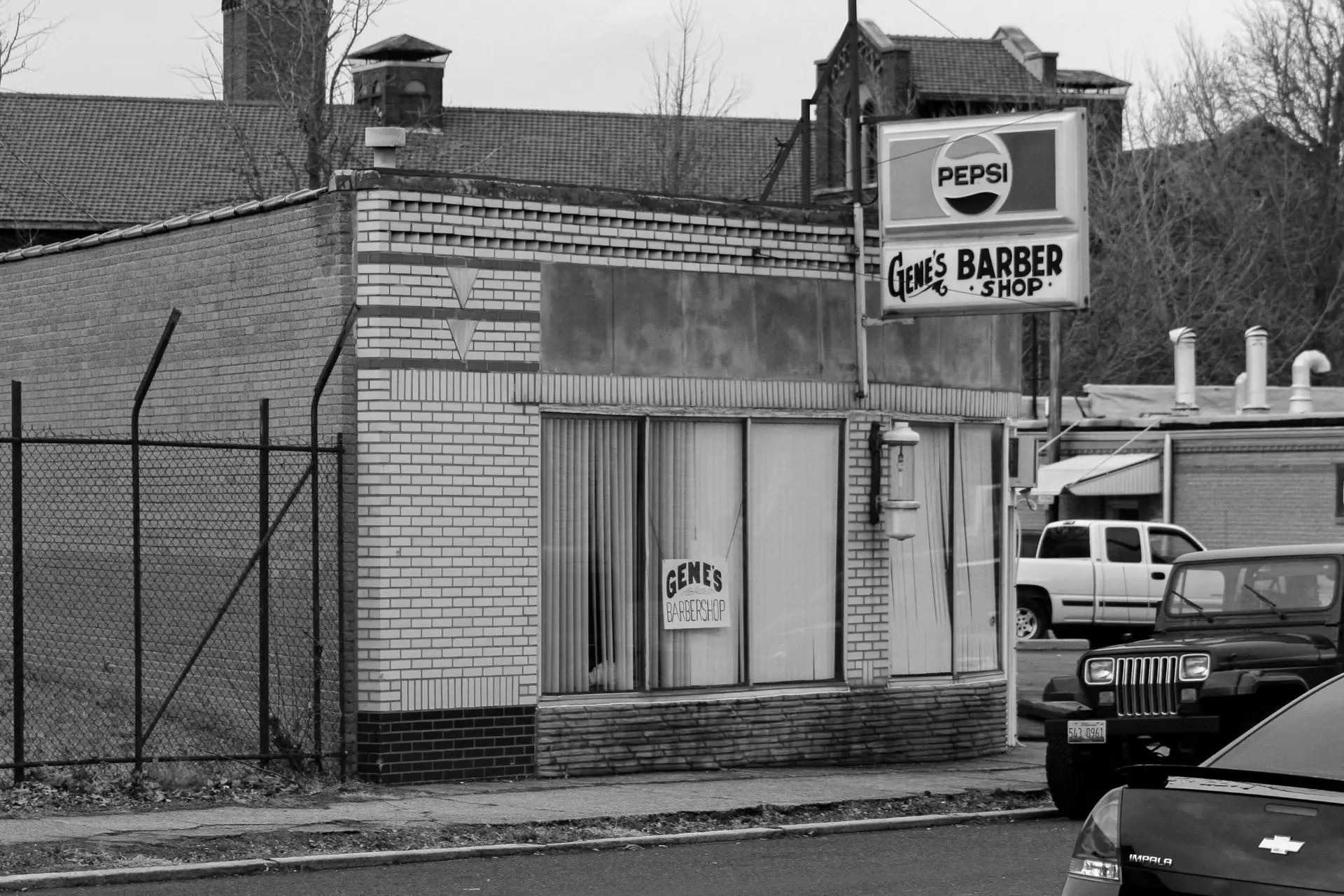
One of my favorite 2006 shots is Gene’s Barber Shop on Southwest. This tiny Art Deco-style building had a curved corner, a black brick base, and strips of beige brick laid at an angle—little details that gave it personality. For decades, Gene cut hair here under a faded Pepsi light box from the late 1960s and a traditional barber pole.

Curved-corner Art Deco building that once housed Gene’s Barber Shop, complete with a faded 1960s Pepsi light box and traditional barber pole. Photographed December 21, 2006 © RJL Creative LLC. Use without permission is strictly prohibited.
Gene passed away in 2018, and the shop closed soon after. I never tracked down what the building was before Gene’s. It may have started as a small service garage or a corner shop. If you know, leave a comment. This neighborhood’s story is best told by the people who lived it.

The Hill Gateway Sign

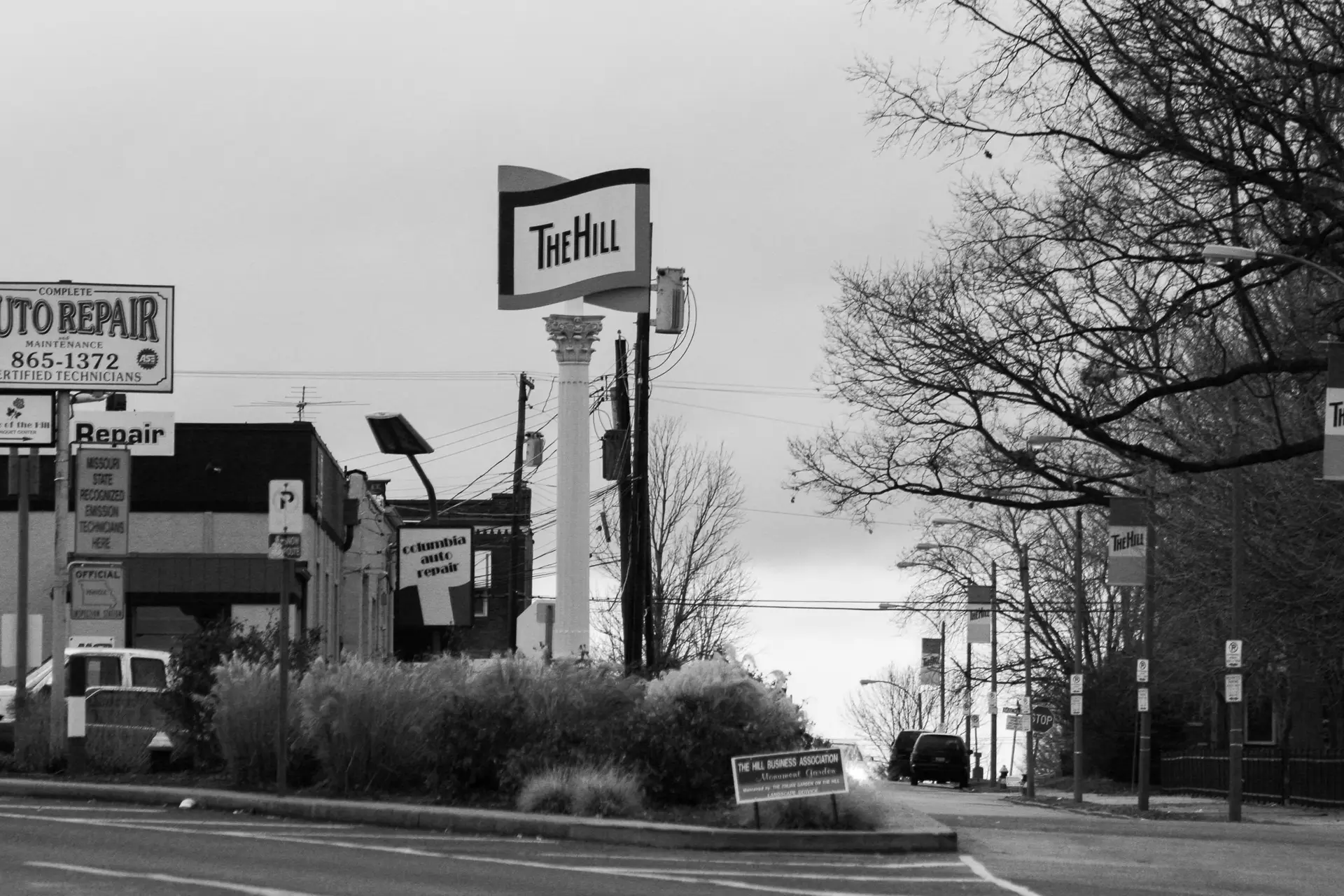
Scroll-shaped “The Hill” sign mounted on a tall white column, framed in red and green like the neighborhood flags along the streets. Photographed December 21, 2006 © RJL Creative LLC. Use without permission is strictly prohibited.
Marking the Entrance

Not far from Gene’s, a small triangular island marks where three streets meet. That is where you’ll find “The Hill” sign mounted on a tall white column. The sign is a scroll-shaped white field with black letters that spell “The Hill,” outlined in red and green.

The same logo appears on vertical flags hanging from light poles across the neighborhood. Usually, there’s one about every block, adding another reminder that you’ve arrived.

From Cassani’s Café to Five Bistro

Where recipes carry the past forward

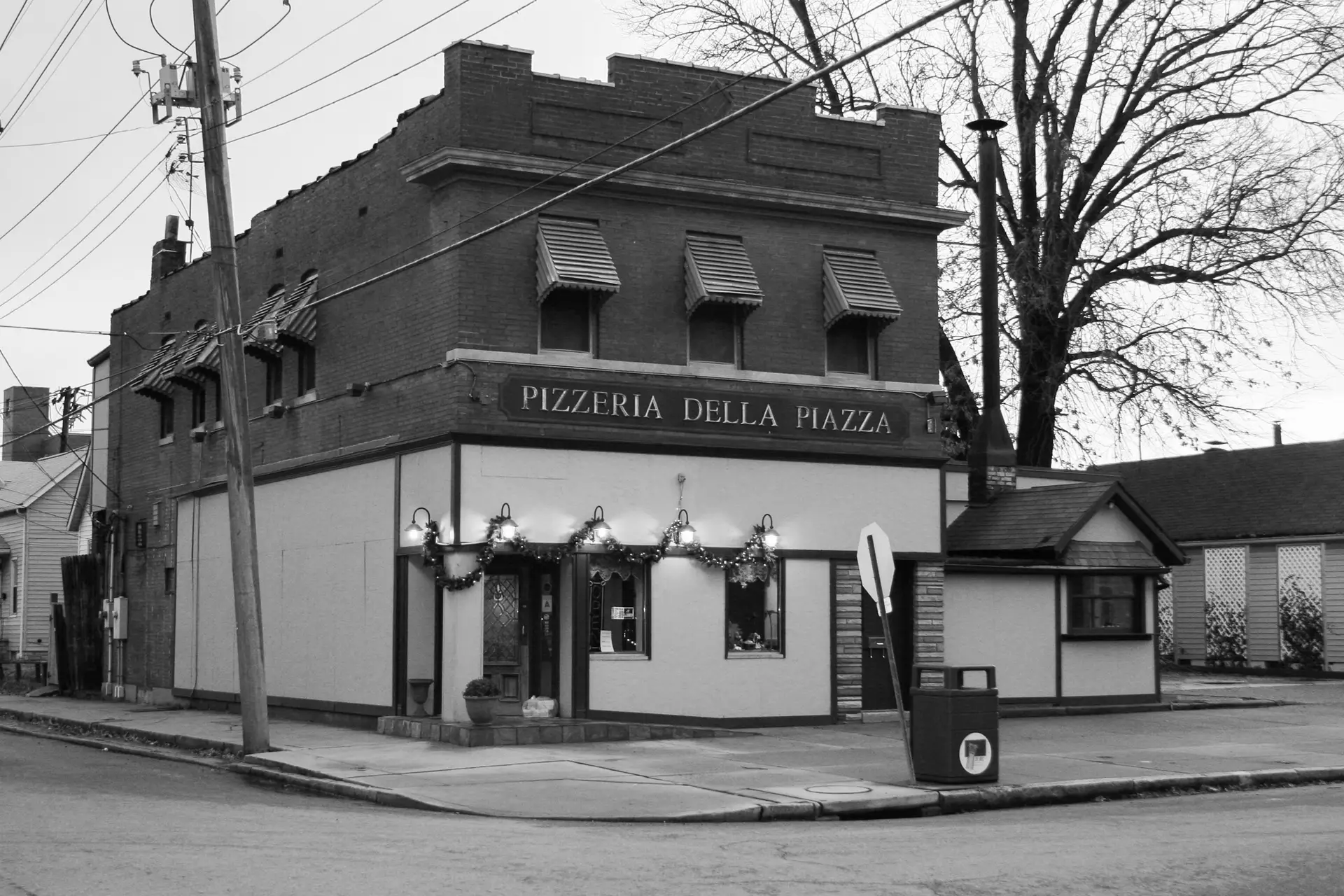
Food is the heart of The Hill, and some of my photos caught buildings that have been feeding people for more than a century. The corner at Daggett and Hereford is one of them. Back in 1909, this two-story building opened with a tavern downstairs and rooms upstairs.

Over the years, it housed Cassani’s Café in the 1940s and Galimberti’s through the 1990s. 

Corner building at Daggett and Hereford that has served food for more than a century, seen here as Pizzeria Della Piazza in 2006. Photographed December 21, 2006 © RJL Creative LLC. Use without permission is strictly prohibited.
When I photographed it in early 2006, it was Pizzeria Della Piazza. Later that year, chef Anthony Devoti opened Five Bistro, eventually rebranding it as J. Devoti Trattoria before closing in 2023. Today, it holds a law office—proof that even in a restaurant-heavy district, not every corner remains in the food business forever.

Art Deco “EAT” Sign

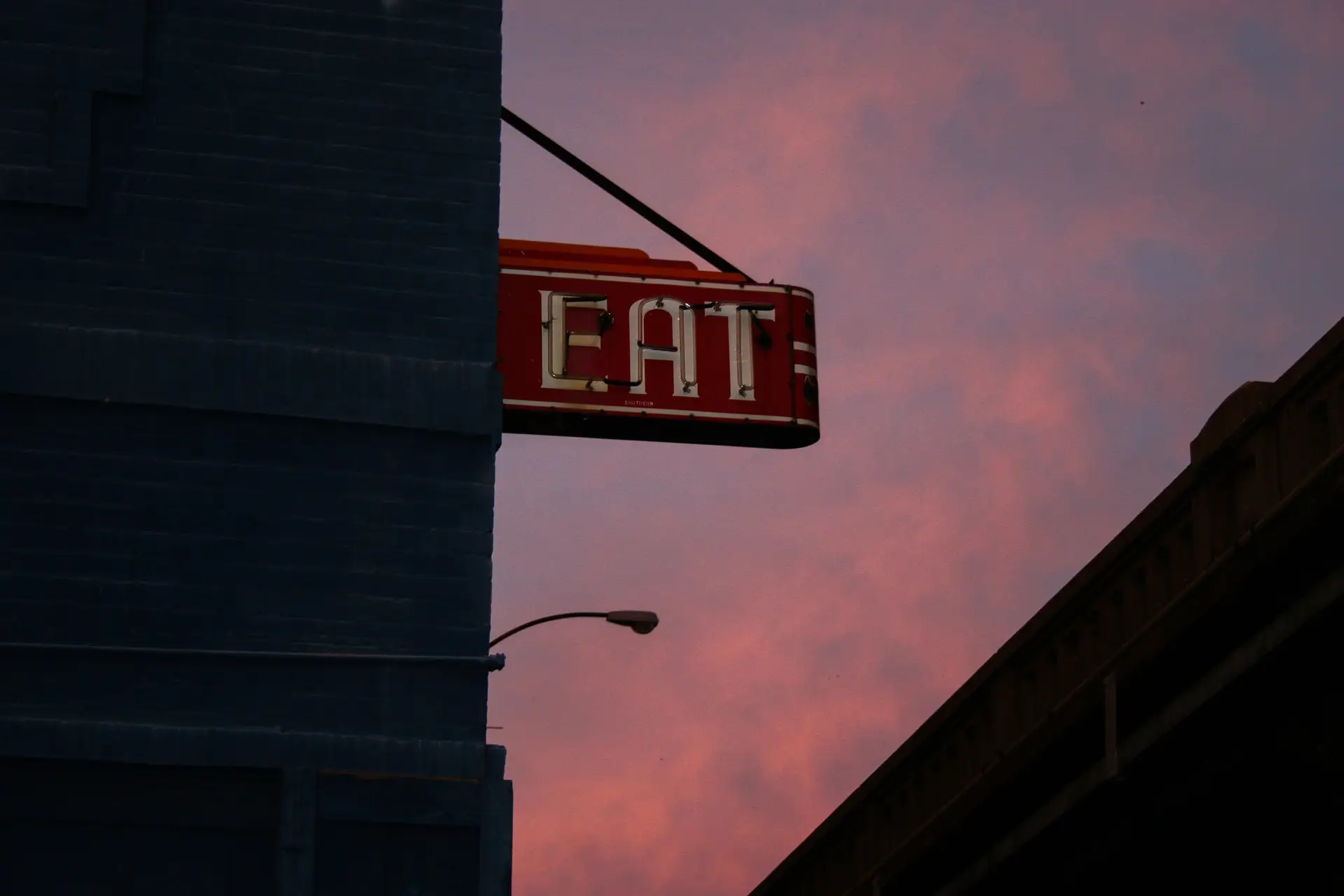
Shuttered blue-painted building near the old Kingshighway viaduct, with an Art Deco neon “EAT” sign from the 1930s or 40s mounted high. Photographed December 21, 2006 © RJL Creative LLC. Use without permission is strictly prohibited.
Daggett Avenue Relic

The giant EAT sign perched on a brick corner building at Southwest and Sublette became one of St. Louis’s most photographed roadside landmarks. It first advertised Fairbanks Grill, then later Sublette’s Tavern, with its bold red letters lighting up the night sky for drivers heading down Southwest Avenue.


The Sign as Symbol

The sign quickly became more than advertising. It stood as a shorthand for The Hill itself — an entire neighborhood of family kitchens, corner taverns, and late-night restaurants. Residents and visitors alike would say, “meet me under the EAT sign.”

Even after ownership changed and the tavern closed, the sign remained as a marker of its legacy. Restorers eventually chose to repair the original rather than replace it, a decision that gave the landmark even more weight. The placement was no accident, either. Builders set it to catch the eyes of motorists, and it succeeded in becoming a neighborhood beacon.

Today, the glowing red letters connect generations. The sign is both practical and nostalgic — a simple command that sums up what The Hill has always offered: food, family, and tradition.

The Birthplace of Toasted Ravioli

St. Louis’s Signature Dish

If The Hill is known for one dish, it’s toasted ravioli. Depending on who you ask, the story changes. One version says it was invented at Oldani’s, now Mama’s on The Hill, in the 1940s when a ravioli accidentally fell into the deep fryer. Another points to Charlie Gitto’s, while Lombardo’s on North Broadway has also claimed the title.

However it began, the recipe stuck. Bread the ravioli, fry it, and serve it with marinara—and you have a St. Louis classic.

Hanneke Hardware and Amighetti’s

A Landmark Reimagined

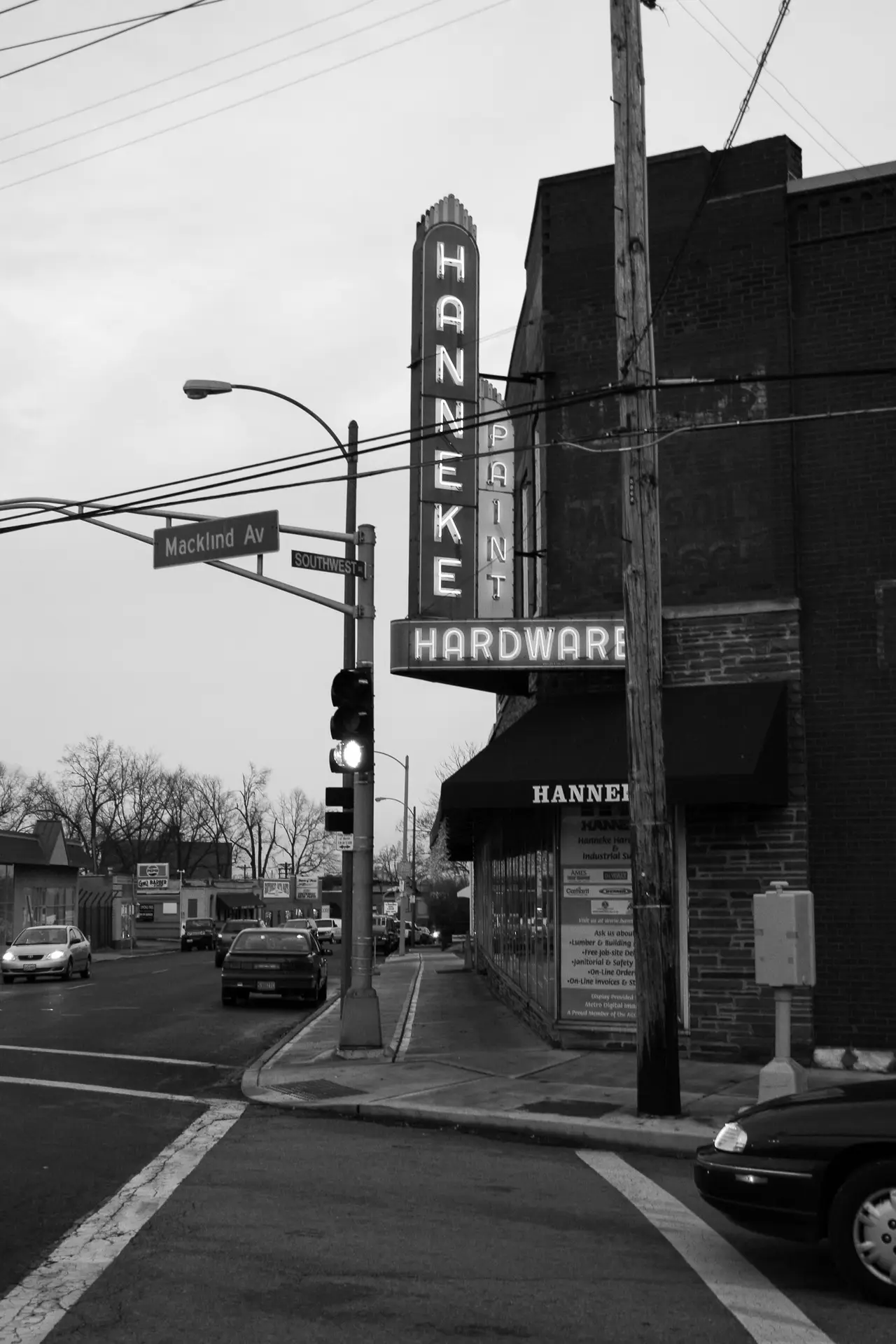
The old Hanneke Hardware building at Southwest and Macklind is a Hill icon with nearly a century of everyday history. Joe and Frank Hanneke opened the store in 1927, and it quickly became a neighborhood constant. You could walk in with a broken hinge or a leaky faucet and leave with the part, a tip, and maybe a story. Shelves held nails, paint, kitchen gadgets, and garden tools. More importantly, the staff knew your name and your project.

After almost ninety years, Hanneke closed in 2015. During renovation, crews uncovered a surprise: sleek green-and-black Vitrolite glass panels from the 1940s hiding under later updates. Restorers decided to preserve what made the façade special. They repaired the glass where they could and matched replacements where they couldn’t.

Restored neon sign on the former Hanneke Hardware building, now home to Amighetti’s sandwich shop and Hank’s Cheesecakes. Photographed December 21, 2006 © RJL Creative LLC. Use without permission is strictly prohibited.
They also brought the neon blade sign back to life rather than swapping it for something new. As a result, the corner regained its familiar glow.

Today the space hums again, this time with food. Amighetti’s anchors the building, carrying on a St. Louis tradition that dates to 1921. The shop’s crusty Italian bread and the Special—stacked with cold cuts, cheese, pickle, and that tangy dressing—still draw a lunch rush. In addition, Hank’s Cheesecakes shares the address, serving rich slices from classic New York to seasonal flavors. Meanwhile, the restored façade ties the past to the present, so the corner feels both new and known.

In the end, the building shows how The Hill evolves without losing itself. Craftsmen kept the materials that matter. New tenants kept the foot traffic. The result is a landmark reimagined, still working for the neighborhood—just in a different way than it did in 1927.

Baseball legends 

From Ruggeri’s to the Majors

The Hill’s ties to baseball run deep. Yogi Berra and Joe Garagiola both grew up here. One of Yogi’s most famous quotes, “Nobody goes there anymore, it’s too crowded,” was about Ruggeri’s, a beloved Hill restaurant. Today, that same building houses The Rose of The Hill banquet center.

Soccer Champions

From The Hill to the World Stage

Baseball wasn’t the only sport that thrived here. In the 1950 World Cup, the U.S. shocked the world by beating England 1–0, and several of the players hailed from The Hill. That victory remains one of the greatest upsets in soccer history. Decades later, the story was brought to film in The Game of Their Lives (2005), which was shot on location in the neighborhood.

Signs of Change

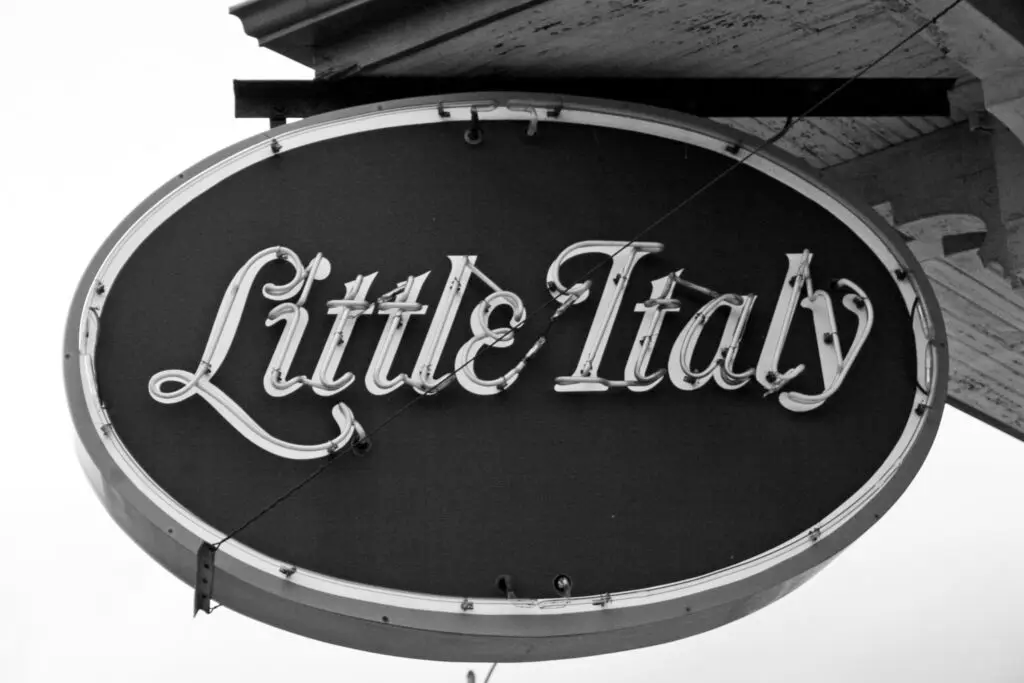
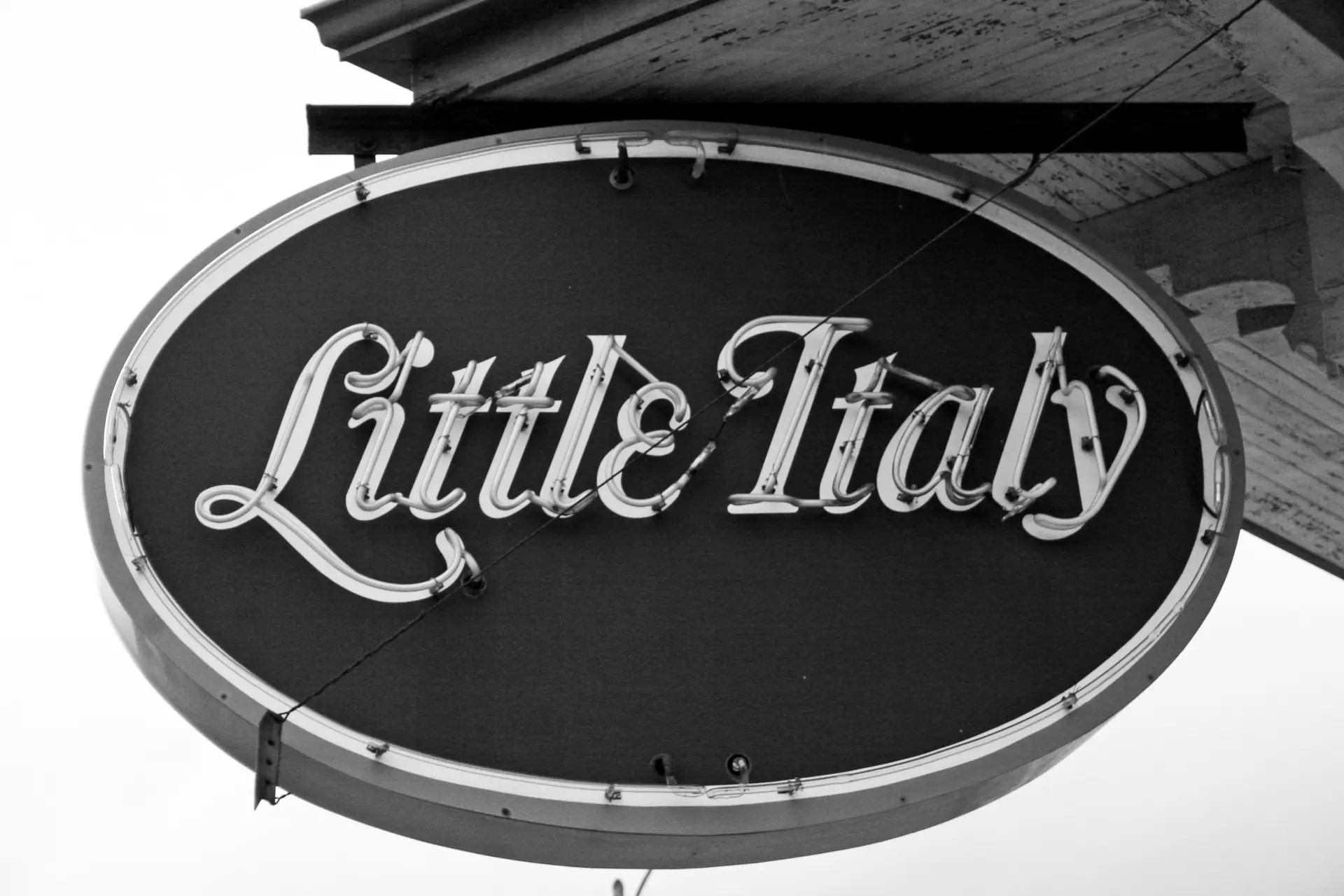
Oval “Little Italy” sign still hanging above the building at 5901 Southwest, once home to Leonardo’s Little Italy and now Amigo Joe’s. Photographed December 21, 2006 © RJL Creative LLC. Use without permission is strictly prohibited.

Little Italy, New Flavors

At 5901 Southwest, the familiar “Little Italy” sign still hangs above the corner storefront, a surviving relic from when Leonardo’s Little Italy filled the building with the smell of garlic and fresh pasta. Through the 1980s and 1990s, its warm neon glow spilled onto the sidewalk, welcoming diners to tables crowded with pizza, pasta, and bottles of Chianti.

For many longtime residents, it wasn’t just a restaurant — it was a place where birthdays, anniversaries, and Sunday suppers unfolded in true Hill fashion.

Mario and Giovanna Bruno brought Leonardo’s here in 1984, weaving it into the rhythm of the neighborhood for a generation. Even after it closed, the sign remained as a marker of its legacy. In 2009, Amigo Joe’s Mexican Restaurant & Cantina took over the space, reusing the old oval sign frame but giving it a new face. The menu shifted from lasagna and linguini to enchiladas and margaritas, a transition that might have seemed unlikely in the heart of St. Louis’s Italian district.

Yet Amigo Joe’s proved that The Hill could embrace new flavors without losing its soul. The restaurant has thrived for more than a decade, drawing both old neighbors and new visitors. The survival of the sign — even as its lettering changed — underscores the neighborhood’s knack for preserving landmarks while letting them evolve. It’s a reminder that The Hill’s story is not just about holding onto tradition, but also about adapting in ways that keep the streetscape alive and relevant.

A Neighborhood That Lives Its Traditions

Heritage in Daily Life

If you’ve spent any time in this neighborhood, you know this is just one story among hundreds. It’s a place where a short walk can bring the smell of fresh bread, the soft thud of bocce balls, and the glow of neon signs holding fast through the years. Here, tradition isn’t just remembered — it’s lived, one day, one meal, and one handshake at a time.

Even as restaurants change and storefronts take on new names, the bones of the buildings and the familiar shapes of the signs keep the neighborhood’s character intact. They act like anchors in the landscape, letting new generations find their own place in a story that’s still unfolding. That’s what makes The Hill in St. Louis more than a destination — it’s a living heritage, sustained by both memory and momentum.

Safe travels, RJ

Want to explore more retro gems? Stay Connected! 👍 Like and follow on Facebook, and 📸 Follow me on Instagram

As an Amazon associate, I earn from eligible purchases. Prices and availability are subject to change. Check the relevant Amazon site for current details.