The Artcraft Theatre Marquee
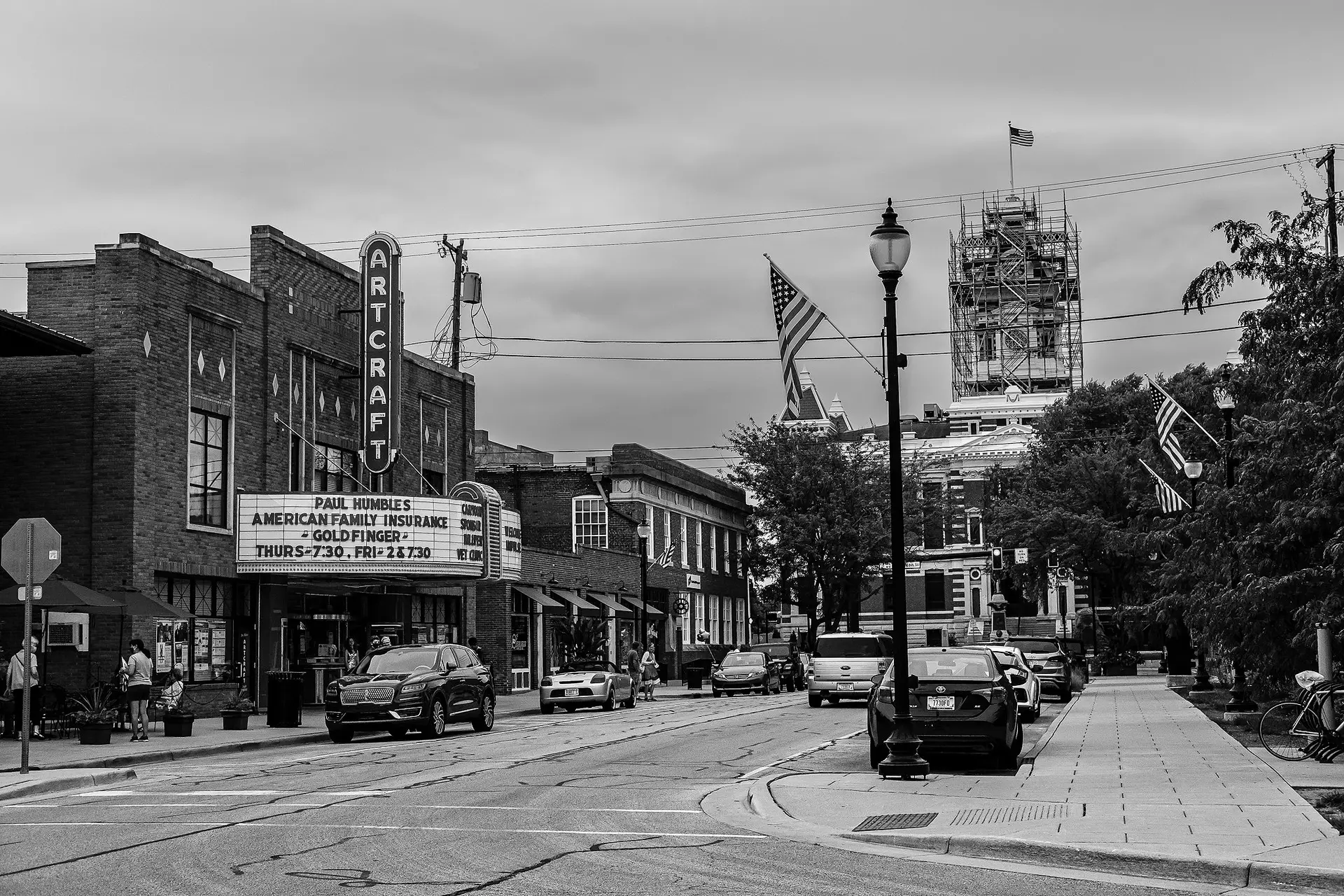
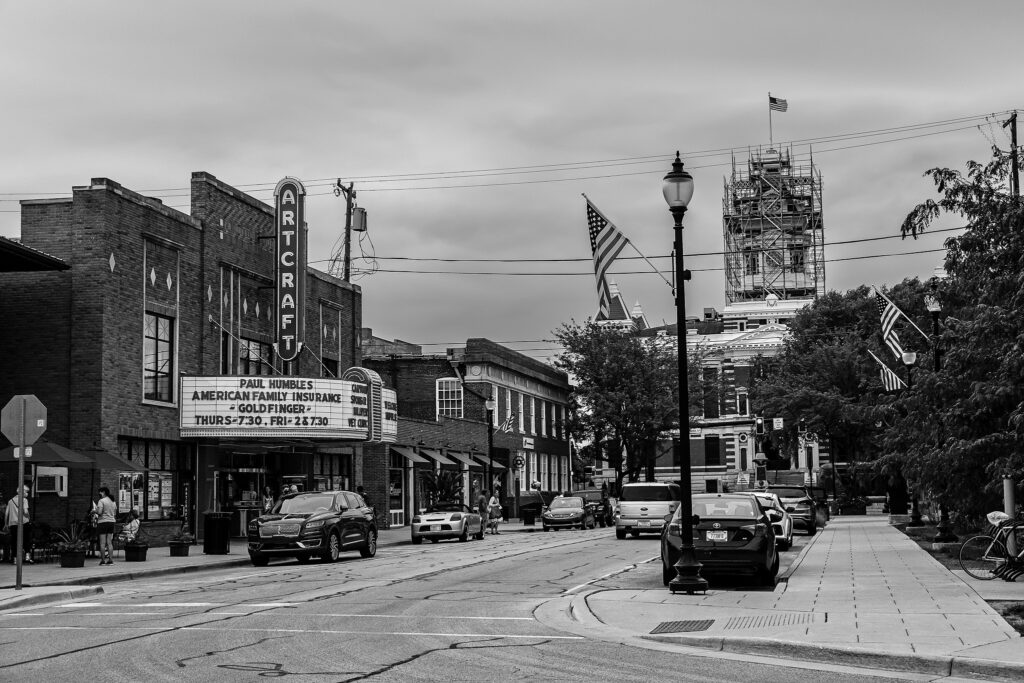
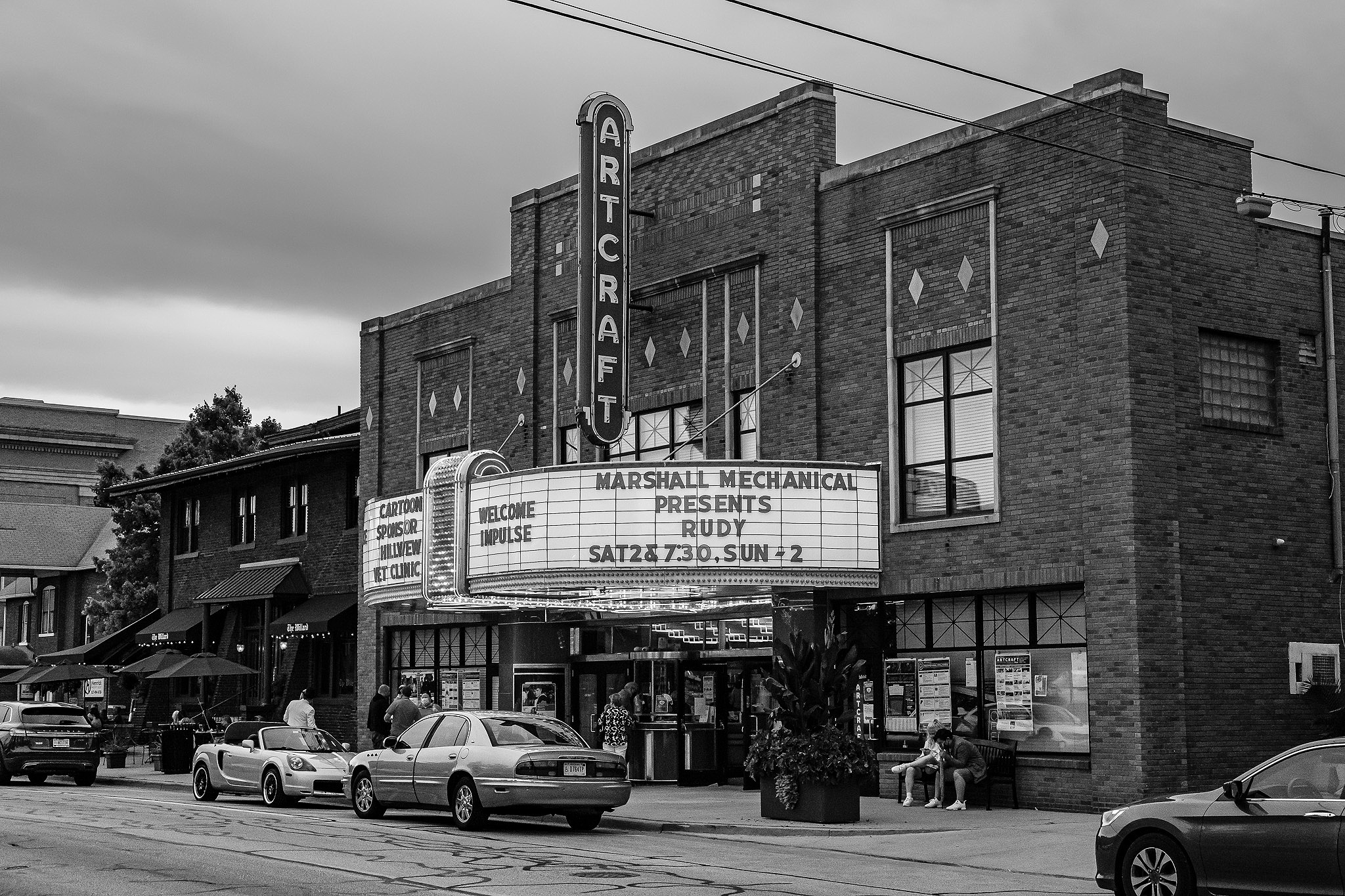
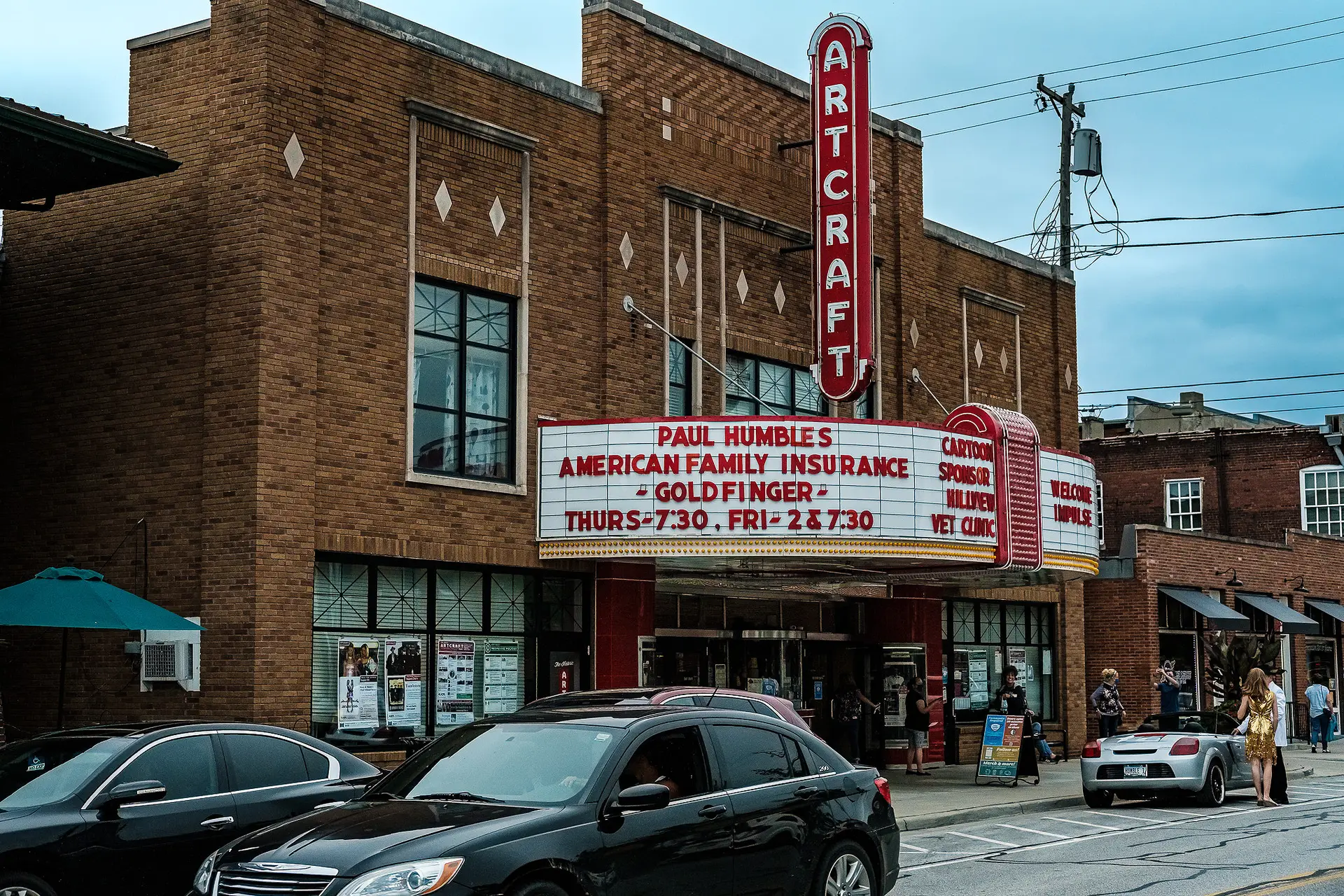
The Artcraft Theatre remains the cultural heartbeat of Franklin, Indiana. My Franklin Indiana downtown photos from July 31, 2020 show the marquee glowing at dusk, its bold letters announcing Goldfinger. That evening, the theater staged more than a screening. Out front sat a sleek European car, a man in a Bond-style suit leaned against it, and a model in a gold dress welcomed passersby.
It was promotion and pageantry, small-town energy meeting Hollywood flair, and it made Jefferson Street buzz.
A Century of History
Opened in 1922, the Artcraft has carried Franklin through a century of change. Designed in Art Deco style, it began with silent films before moving into talkies, Technicolor,-
and family matinees. For decades, it anchored school trips, weekend outings, and community events. By the late 20th century, when many small-town theaters closed, the Artcraft held on. Its survival owes much to Franklin Heritage, Inc., which stepped in during the 2000s to restore and protect the building.
The Marquee as Symbol
Today the Artcraft thrives as both a historic landmark and a working venue. Film revivals, concerts, and lectures continue to draw crowds. Its marquee, captured in my Franklin Indiana downtown photos, is more than signage—it is a symbol of continuity. Neon that once lit the sidewalks of the 1930s still glows for new generations.
The Bond promotion reminded me that the Artcraft doesn’t just replay films; it creates experiences. By blending history with imagination, the theater proves that Franklin’s downtown is not frozen in time but alive, vibrant, and ready for its next act.
The Courthouse Dome Under Renovation
From many angles in Franklin, the Johnson County Courthouse defines the skyline. My Franklin Indiana downtown photos from July 31, 2020 captured it wrapped in scaffolding, the dome surrounded by steel poles as crews worked high above the square. Even in partial disguise, the courthouse projected permanence. Built in 1879, the structure has witnessed over a century of local history—trials, celebrations, and daily courthouse-
business that shaped Johnson County life. The renovation I photographed that summer showed a community unwilling to let its most iconic landmark fade.
A Landmark Since 1879
The courthouse dome has long served as Franklin’s compass point, visible from streets leading into the square. Its profile gives the town a sense of place, a reminder that civic life has a center. In my Franklin Indiana downtown photos, the scaffold itself becomes symbolic. While some might see obstruction, I saw preservation in action—a careful effort to protect what anchors Franklin’s identity.
Preservation as Progress
Renovation projects are never easy. They demand money, patience, and vision. Yet Franklin pressed ahead, even while other towns let courthouses crumble or replace them with modern offices. The decision to restore, rather than replace, reflects a respect for heritage that defines this community. It is an investment not only in bricks and copper but also in civic pride.
Standing there with my camera, I thought of how generations had walked these same sidewalks, looking up at the dome as part of their daily routine. The scaffolding meant future generations would do the same. My Franklin Indiana downtown photos record not just a building, but a commitment: Franklin intends to preserve its history while making sure its most recognizable symbol endures.
The Tavern Grill
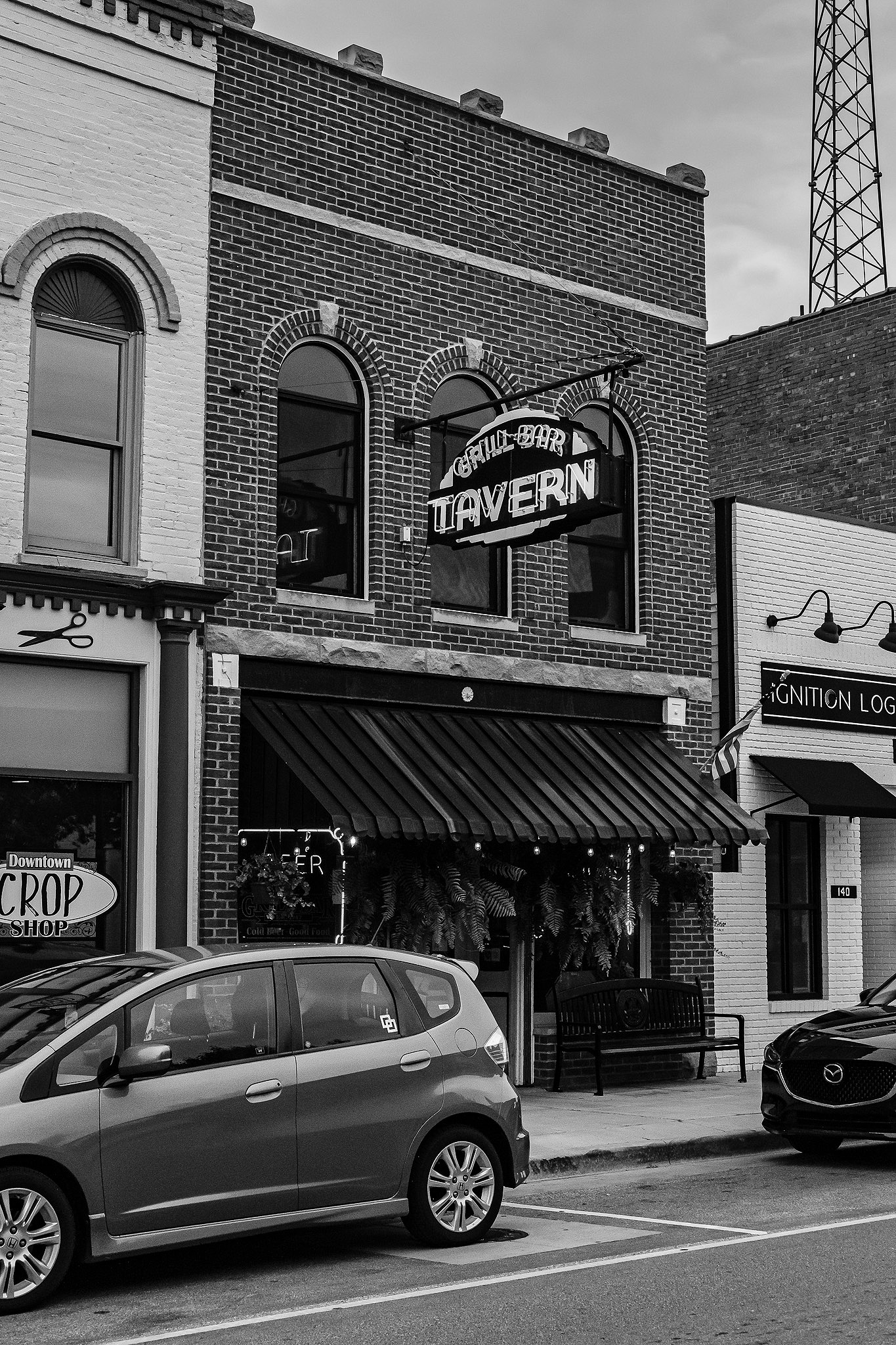
On Jefferson Street, the Tavern Grill stands as one of Franklin’s most familiar façades. My Franklin Indiana downtown photos from July 31, 2020 show its brick exterior steady against the street, the kind of place that speaks to routine as much as occasion. For decades, this restaurant and bar has been a gathering spot for courthouse employees on lunch break, students looking for a quick bite, and longtime locals who know the booths almost as well as their own kitchens. It isn’t the grand architecture of the courthouse or the Artcraft Theatre, but in many ways, the Tavern Grill is just as essential to Franklin’s character.
What makes places like the Tavern matter is their constancy. They are everyday anchors, the places where news is shared and celebrations are made casual. In my Franklin Indiana downtown photos, the Tavern looks paused, waiting for the next round of-
conversation. That sense of expectancy defines Jefferson Street—businesses that welcome connection as much as commerce.
The Tavern Grill’s legacy comes not just from food and drink but from familiarity. Patrons know the staff, the view out the front window, even the feel of the sign overhead. These details matter as much as any historic landmark because they build community memory. To capture the Tavern is to photograph a piece of Franklin’s daily life.
The Tavern Grill Neon Sign
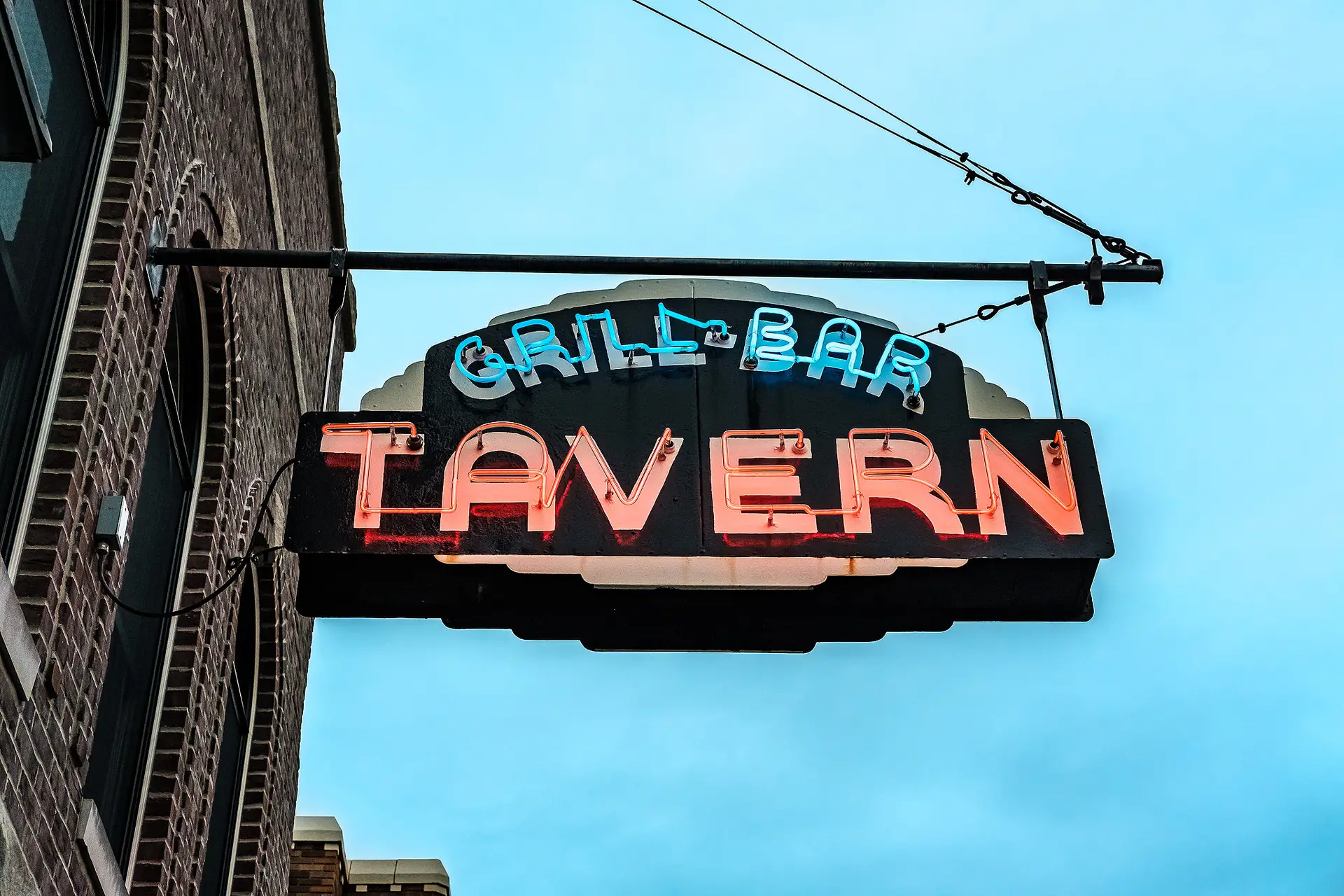
Among my Franklin Indiana downtown photos, the Tavern Grill’s neon sign deserved special attention. Suspended over the sidewalk, it commands the street with mid-century charm. Even by daylight, the sign glows as if reminding passersby that Franklin’s evenings have long been lit by neon. Signs like this are more than-
advertisements; they are landmarks in themselves. Locals recall meeting beneath them, visitors remember their glow, and photographers like me find them irresistible.
In Franklin, the Tavern’s neon works as a symbol of continuity. While menus and faces may change, the sign remains. Neon has always stood for promise along America’s streets—promise of a meal, a drink, or a moment shared. The Tavern Grill’s sign still carries that meaning. To me, it wasn’t just decoration for a building, but a bright reminder that small-town traditions remain visible, glowing above Jefferson Street like a welcome you can’t miss.
Elks Lodge at 56 Jefferson Street
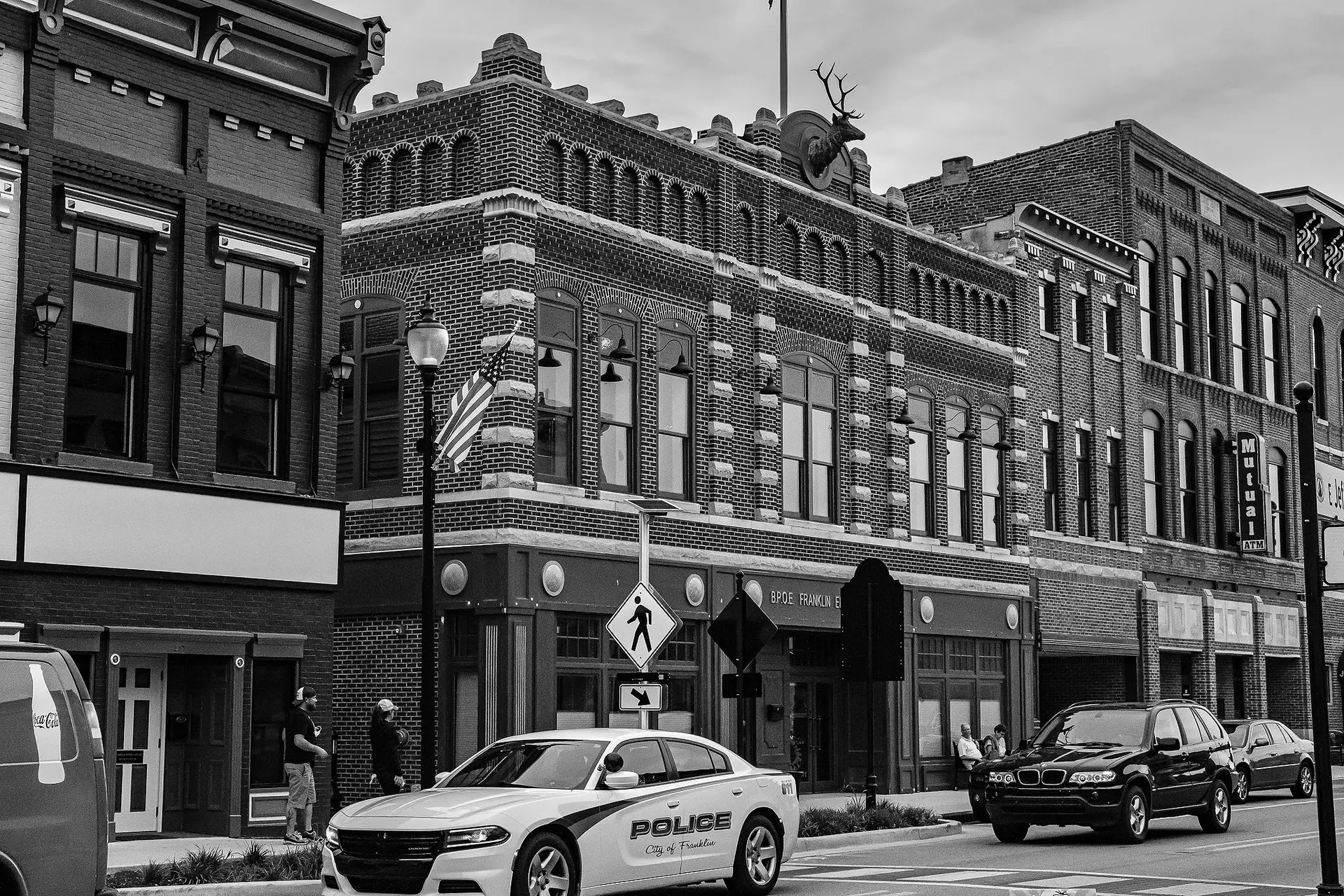
On Jefferson Street, the Elks Lodge #1818 stands as a reminder of community life in Franklin. My Franklin Indiana downtown photos from July 31, 2020 captured its brick façade steady and dignified, the kind of building that speaks of tradition rather than fashion. While less ornate than the courthouse or the Artcraft Theatre, the Elks Lodge carries its own weight in the town’s story.
For decades, it has been a place where neighbors gathered not just for events but for fellowship, charity, and civic pride.
A National Tradition with Local Roots
The Benevolent and Protective Order of Elks was founded nationally in 1868, and lodges quickly spread to small towns across America. Franklin’s chapter, Lodge #1818, became part of that network of fraternal organizations that balanced social connection with community service. The building at 56 Jefferson Street is more than brick and mortar; it represents countless dinners, fundraisers, and meetings where residents worked together to support each other. My Franklin Indiana downtown photos of the lodge capture not just architecture but the presence of a tradition woven into local life.
Steadfast Through Changing Times
The Elks Lodge has endured shifts that caused other institutions to fade. Wars, depressions, and recessions passed, yet the organization remained. Even when other community halls disappeared, the Elks persisted, adapting while staying true to their mission of service and fellowship. To see the lodge on Jefferson Street is to see stability in physical form.
When I photographed the building, I thought about how many generations had walked through its doors. Each left their mark not with construction but with participation. The Elks Lodge is proof that Franklin’s history rests not only on its grand landmarks but also on the quieter spaces where people choose to come together. My Franklin Indiana downtown photos of 56 Jefferson Street preserve that sense of continuity, a story of civic spirit that still resonates today.
10 Pins Bowling and Coffeehouse Five
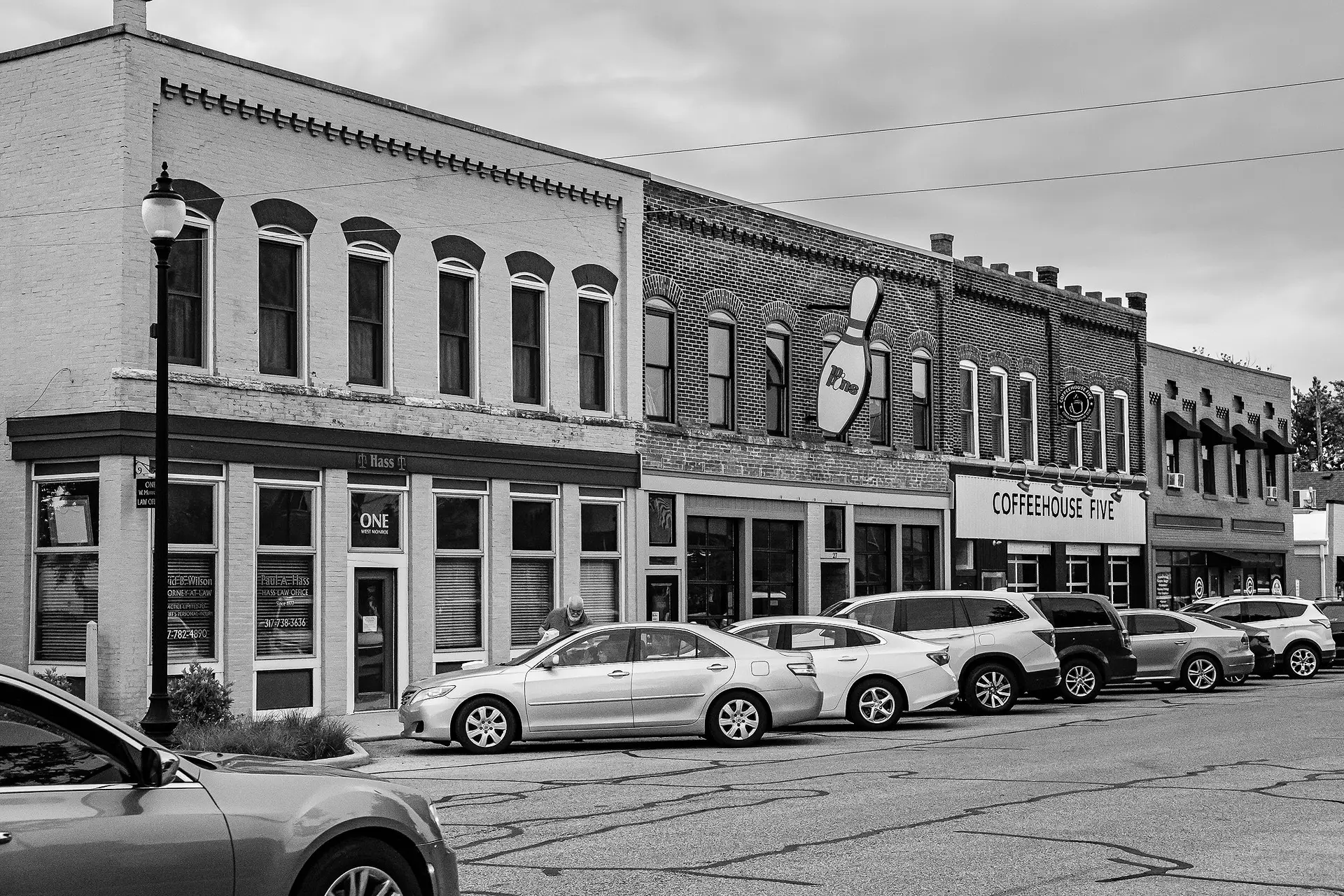
On Jefferson Street, one of Franklin’s more surprising pairings sits side by side: 10 Pins Bowling Alley and Coffeehouse Five. My Franklin Indiana downtown photos from July 31, 2020 show the two businesses sharing one building, their signage stacked together like a snapshot of different eras. It’s a combination that seems unlikely at first glance—bowling on one side, coffee on the other—yet it reflects-
the way Franklin blends tradition with modern routine.
Bowling as Americana
Bowling alleys were once among the most popular gathering spots in small-town America. From the 1950s through the 1970s, leagues filled alleys every week, and the sound of pins crashing became part of community life. In Franklin, 10 Pins carries that tradition forward. My Franklin Indiana downtown photos captured its presence not only as entertainment but as a reminder of how leisure once defined local rhythms. While many towns saw their alleys shutter, Franklin kept the lanes alive, a place where friends still meet under the glow of familiar signage.
Coffee for a New Generation
On the other side of the building, Coffeehouse Five represents the opposite end of the cultural spectrum. Coffee shops today serve as morning rituals, study halls, and places where conversations begin. In Franklin, Coffeehouse Five does more than serve espresso—it functions as a hub for connection, often tied to community programs and events. Seeing its name alongside 10 Pins shows how Franklin has adapted, offering both mid-century recreation and modern-day routine under one roof.
As rain clouds drifted over Jefferson Street that afternoon, I thought about how this combination illustrates Franklin’s balance between heritage and change. My Franklin Indiana downtown photos preserve that contrast: the crash of pins beside the hum of conversation, tradition and modernity coexisting on the same block. It is one of the small details that makes Franklin’s downtown unique.
Ann’s Restaurant
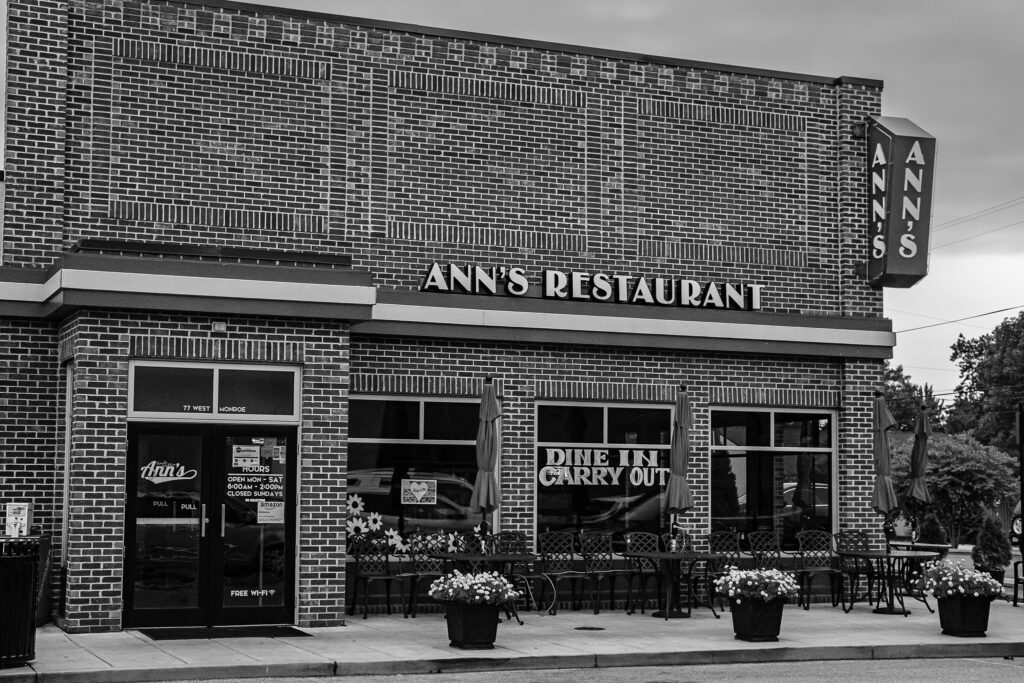
Ann’s Restaurant is a longtime gathering spot in Franklin. Photographed July 31, 2020 © RJL Creative LLC. Use without permission is strictly prohibited.
On Jefferson Street, Ann’s Restaurant stands as a beloved Franklin institution. My Franklin Indiana downtown photos from July 31, 2020 capture the restaurant’s modest façade—unassuming, familiar, and rooted in local memory. But what those images don’t show is the story behind the sign, one that stretches back to the 1950s.
From Alta’s Place to Ann’s
Founded in 1952, the eatery began as Alta’s Place, a tiny 13-seat diner in the old Suckow Building at 99 West Jefferson. Alta Spicer and her brother, Elton Leach, ran it in 12-hour shifts, serving locals from Franklin College, factory workers, and even Camp Atterbury servicemen. Customers paid mere dimes for burgers and coffee. Eventually, growth demanded a new location, and Floyd and Erzel Vanlaningham built a larger space at 77 West Monroe Street—doubling the seating.
When Elton passed away in 1966, Alta’s sister Ann Daugherty joined the business and, after Alta retired, renamed it Ann’s Restaurant. The restaurant’s identity was both inherited and reshaped—and the change stuck.
Rising from the Ashes
A devastating fire in 1987 destroyed the building. But closing wasn’t an option. Ann rebuilt immediately, and by December 14 of that year, Ann’s reopened with room for 100 diners and multi-level seating like the “Loft” and “Upper Room.” Though new in appearance, the restaurant held on to its heritage, becoming both Franklin’s oldest dining spot and its freshest look.
Food Truck Party on the Square
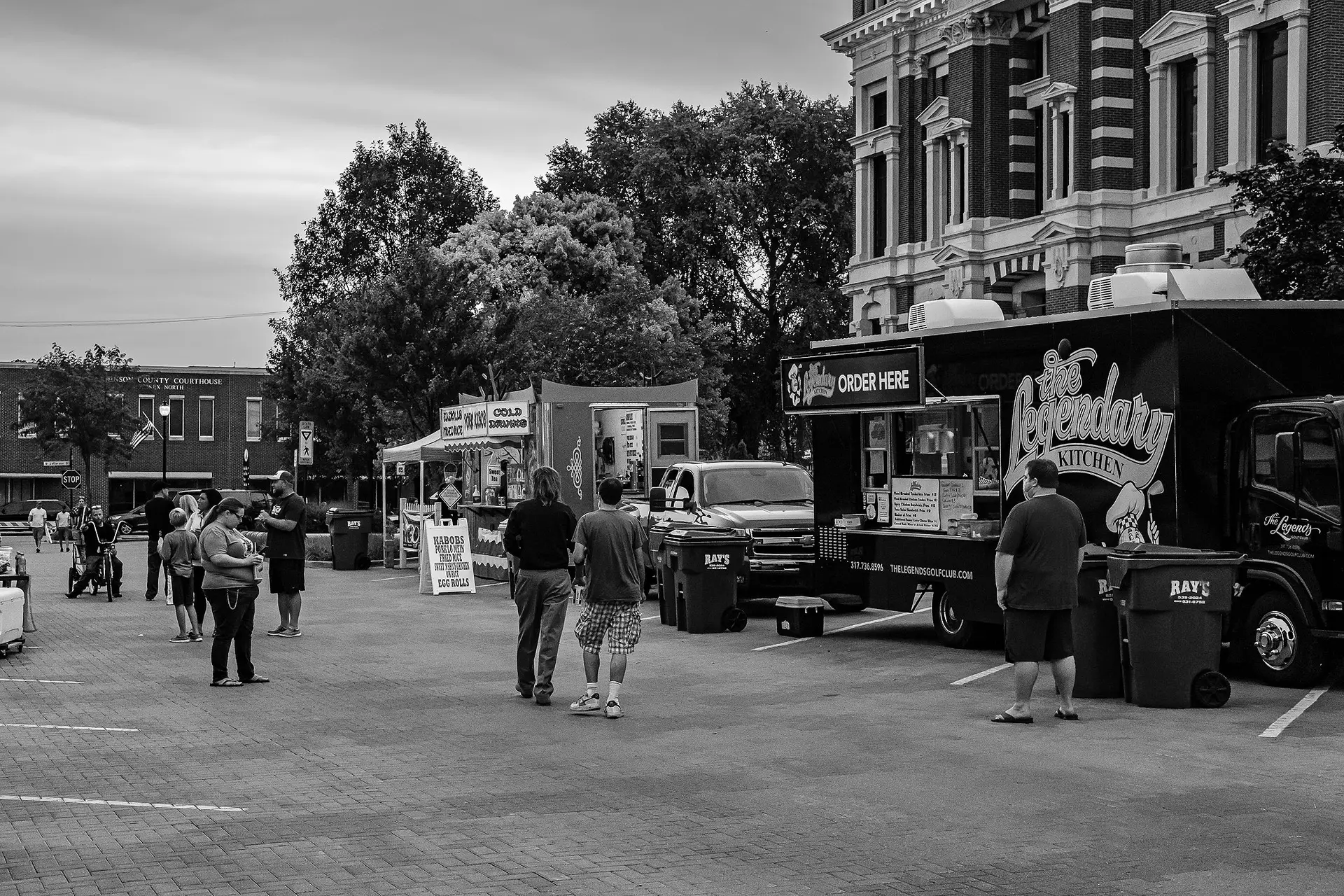
Late on July 31, 2020, my Franklin Indiana downtown photos captured a lively food truck party near the courthouse square. It was just after five in the afternoon, with clouds gathering overhead and the aroma of sizzling food drifting down Jefferson Street. The courthouse, wrapped in scaffolding, provided a striking backdrop. In front of it, folding tables, colorful trucks, and clusters of families and friends filled the square with activity.
A Modern Twist on the Courthouse Square
Franklin’s courthouse square has always been more than a place for official business. For generations, it has hosted parades, community celebrations, and casual gatherings. The addition of food trucks brings that tradition into a modern rhythm. Instead of speeches or ceremonies, the square now fills with the clatter of food prep, the smell of barbecue or tacos, and the chatter of neighbors catching up over dinner. In my Franklin Indiana downtown photos, the juxtaposition of courthouse restoration and food vendors tells a simple story: heritage and modern culture can thrive side by side.
Food, Community, and Connection
What struck me most wasn’t just the food but the atmosphere. Workers grabbed a quick bite after their shifts. Parents shared snacks while kids played on the sidewalks. Couples stood talking with plates in hand as the courthouse dome rose behind them. Even as storm clouds rolled closer, the sense of connection remained.
Events like this show how Franklin adapts while staying true to its character. The courthouse reminds residents of endurance; the food trucks add vibrancy. Together they form a portrait of small-town life that is both historic and contemporary. My Franklin Indiana downtown photos captured more than vendors and buildings—they recorded a town square alive with people making the most of their Friday evening.
Closing Reflections on Franklin
Together, these images form more than a casual record—they tell the story of a community. My Franklin Indiana downtown photos from July 31, 2020 capture a town that values its past yet continues to move forward. From the glow of the Artcraft Theatre’s marquee to the steady presence of the Elks Lodge, Franklin reveals itself through landmarks that anchor both history and daily life.
A Blend of Heritage and Everyday Life
The courthouse dome, under renovation yet still commanding the square, symbolizes Franklin’s respect for preservation. The Tavern Grill and Ann’s Restaurant highlight the importance of familiar gathering spots, where meals and conversations become part of the town’s fabric. Even the combination of 10 Pins Bowling and Coffeehouse Five shows adaptability—mid-century leisure living comfortably alongside modern routines. My Franklin Indiana downtown photos record this blend of heritage and everyday life, where both carry equal weight in shaping the identity of the town.
Continuity in a Changing World
What stood out most in Franklin was continuity. Historic buildings have been restored rather than replaced. Restaurants and taverns endure across generations. Even new elements, like the food truck party near the courthouse square, feel less like disruption and more like a natural extension of community tradition. Small towns thrive when people treat the past as a foundation, not a burden. Franklin demonstrates this through every preserved landmark and every gathering space still in use.
In the end, my Franklin Indiana downtown photos offered more than architecture or events—they revealed a town committed to resilience. The lights, the signs, the meals, and the conversations all work together to create a living portrait of Franklin. It is a place where history and community remain inseparable, ensuring that downtown continues to speak to anyone willing to pause and listen.
Safe travels, RJ.